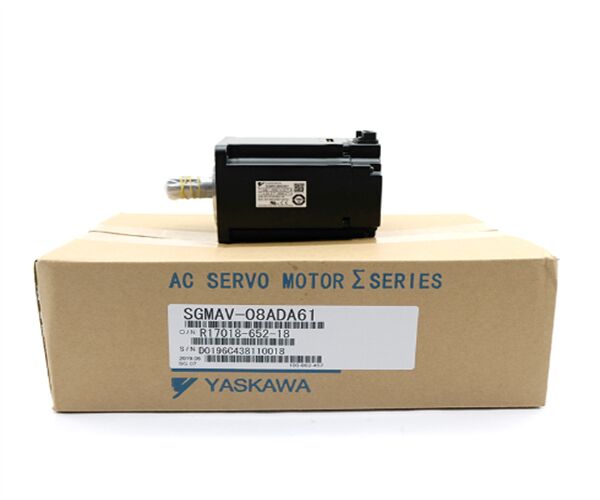
Description of SGMAV-08ADA61
The SGMAV-08ADA61 model from Yaskawa's Sigma II lineup is a highly capable servo motor. It can achieve a rated torque of 2.39 Newton meters, while its maximum torque rating extends to 7.16 Newton meters. Engineered for precision, this motor can operate at a rated speed of 3,000 revolutions per minute, and it is designed to handle a peak speed of up to 6,000 revolutions per minute as needed.
With a current rating of 5.3 Amperes, the servo motor boasts a maximum current consumption of 16.6 Amperes, making it suitable for significant load applications. The insulation is classified as Class B, which is appropriate for various uses in industrial environments. This motor employs a direct drive method, ensuring efficient power transmission.
Regarding temperature specifications, the SGMAV-08ADA61 operates effectively in ambient conditions ranging from 0 to 40°C without condensation. Meanwhile, it is designed to withstand storage temperatures that vary from -20 to 85°C. It also has a protection rating of IP65, indicating dust-tight construction and protection against water jets. This combination of features makes the Yaskawa SGMAV-08ADA61 servo motor a strong candidate for demanding automation and control applications.
| Manufacturer | Yaskawa |
|---|---|
| Product Type | Servo Motor |
| Product Line | Sigma II |
| Part Number | SGMAV-08ADA61 |
| Weight | 5.00 lbs (2.27 kg) |
| Rated Torque | 2.39 Newton-meter |
| Rated Speed | 3,000 revolutions per minute (RPM) |
| Maximum Torque | 7.16 Newton-meter |
| Current Rating | 5.3 Amperes |
| Ambient Operating Temperature | 0 to 40°C (in a non-condensing environment) |
| Maximum Current | 16.6 Amperes |
| Insulation Class | Class B |
| Drive Method | Direct drive |
| Input Phase Type | 3-phase input |
| Maximum Speed | 6,000 revolutions per minute (RPM) |
| Rated Output | 750 Watts |
| Protection Class | IP65 |
| Storage Temperature | -20 to 85°C (in a non-condensing environment) |
The Yaskawa SGMAV-08ADA61 servo motor from the Sigma II series is designed for high-performance applications. It delivers a rated torque of 2.39 Newton-meters and a maximum torque of 7.16 Newton-meters, supporting a rated speed of 3,000 RPM and reaching up to 6,000 RPM.
Similar Products
| SERVO_DRIVER,YASKAWA,SGDV-R70A05A |
| SERVO_MOTOR,YASKAWA,SGMAH-04AAA2C |
| SERVO_DRIVER,YASKAWA,SGDV-180A05A |
| SERVO_DRIVER,YASKAWA,SGDS-20A05A |
| SERVO_DRIVER,YASKAWA,SGDS_75A05A |
| AC_MOTOR),YASKAWA,SGMAH-A3A1A41 |
| SERVO_DRIVER,YASKAWA,SGDS-15A12A |
| SERVO_MOTORYASKAWA,SGMCS-16E3B11 |
| SERVO_MOTORYASKAWA,SGMAS-08ACAH761 |
| SERVO_MOTOR,YASKAWA,SGMAS-04A2A21 |
| SERVO_MOTOR,YASKAWA,SGMAH-02A1A21 |
| SERVO_MOTOR,YASKAWA,SGMAH-08A1A21 |
| SERVO_DRIVER,YASKAWA,SGDV-120A15A |
| SERVO_DRIVER,YASKAWA,SGDV-120A11A |
| SERVO_DRIVER,YASKAWA,SGDV-R70A11A |
| SERVO_DRIVER,YASKAWA,SGDV-R70A15A |
| SERVO_DRIVER,YASKAWA,SGDV-1R6A11A |
| SERVO_DRIVER,YASKAWA,SGDV-2R8A11A |
| SERVO_DRIVER,YASKAWA,SGDV-5R5A11A |
| SERVO_DRIVER,YASKAWA,SGDV-200A11A |
| SERVO_DRIVER,YASKAWA,SGDV-200A15A |
| AC_MOTOR,YASKAWA,SGM7A-10AFA6C |
| SERVO_DRIVER,YASKAWA,SGD7S-120AE0A |
| SERVO_DRIVER,YASKAWA,SGDM-50ADA |
| SERVO_DRIVER,YASKAWA,JZNC-XRK01D |
| SERVO_DRIVER,YASKAWA,SGDV-330A11A |
| SERVO_MOTOR,YASKAWA,SGDV-R90A01B |
| SERVO_DRIVER,YASKAWA,SGDV-R90A11A |
| SERVO_MOTOR,YASKAWA,SGMPH-04AAA41 |
| SERVO_DRIVER,YASKAWA,SGDH-02AE |
| SERVO_MOTORYASKAWA,SGDV-R70A01A |
| SERVO_DRIVER,YASKAWA,SGDS-15A05A |
| SERVO_DRIVER,YASKAWA,SGDS-01A05A |
| SERVO_MOTOR,YASKAWA,SGMPH-08AAAH12C |
| SERVO_MOTOR,YASKAWA,SGMGH-09ACA2C |
| SERVO_DRIVER,YASKAWA,SGDV-R90F01A |
| SERVO_DRIVER,YASKAWA,SGDV-1R6A15B |
| SERVO_MOTOR(,YASKAWA,SGMPH-08AAA2C |
| LINEAR_MOTOR,YASKAWA,SGLFW-35A230AP |
| SERVO_MOTOR(,YASKAWA,SGMAS-12A2A21 |
| SERVO_MOTOR(,YASKAWA,SGMAH-02AAA21 |
| SERVO_MOTOR(,YASKAWA,SGMAS-A5A2A41 |
| SERVO_DRIVER,YASKAWA,SGDM-08ADA-Y116 |
| SERVO_DRIVER,YASKAWA,SGDM-20ADA |
| SERVO_DRIVER,YASKAWA,SGDR-EH130RY55 |
| SERVO_MOTOR,YASKAWA,SGM-08A314C |
| SERVO_MOTOR(,YASKAWA,SGDV-R70A11B |
| SERVO_MOTOR(,YASKAWA,SGMAH-08AAA2B |
| LINEAR_MOTOR(,YASKAWA,SGLGW-30A080CP |
| SERVO_DRIVER,YASKAWA,JASP-WRCA01B |
| SERVO_MOTOR,YASKAWA,SGDV-5R5A15A |
| SERVO_MOTOR),YASKAWA,SGMAH-02AAA2B |
| SERVO_MOTOR,YASKAWA,SGMPH-15AAA41 |
| SERVO_MOTOR,YASKAWA,SGM-01A314 |
| SERVO_MOTOR,YASKAWA,SGDS-30A05A |
Stepping Modes
The following are the most common drive modes.
• Wave Drive (1 phase on)
• Full Step Drive (2 phases on)
• Half Step Drive (1 & 2 phases on)
• Microstepping (Continuously
varying motor currents)
For the following discussions please refer to the figure 6.
In Wave Drive only one winding is energized at any given time. The stator is energized according to the
sequence A → B → A → B and the rotor steps from position 8 → 2 → 4 → 6. For unipolar and bipolar wound motors with the same winding parameters this excitation mode would result in the same mechanical position. The disadvantage of this drive mode is that in the unipolar wound motor you are only using 25% and in the bipolar motor only 50% of the total motor winding at any given time. This means that you are not getting the maximum torque output from the motor
In Full Step Drive you are energizing two phases at any given time. The stator is energized according to
the sequence AB → AB → AB → AB and the rotor steps from position 1 → 3 → 5 → 7 . Full step mode results in the same angular movement as 1 phase on drive but the mechanical position is offset by one half of a full step. The torque output of the unipolar wound motor is lower than the bipolar motor (for motors with the same winding parameters) since the unipolar motor uses only 50% of the available winding while the bipolar motor uses the entire winding.
Half Step Drive combines both wave and full step (1&2 phases on) drive modes. Every second step only
one phase is energized and during the other steps one phase on each stator.
The stator is energized according to the sequence AB → B → AB → A → AB → B → AB → A and the
rotor steps from position 1 → 2 → 3 → 4 → 5 → 6 → 7 → 8. This results in angular movements that are half of those in 1- or 2-phases-on drive modes. Half stepping can reduce a phenomena referred to as resonance
which can be experienced in 1- or 2- phases-on drive modes.
SYNCHRONOUS SPEED
The speed with which the stator magnetic field rotates, which will determine the speed of
the rotor, is called the Synchronous Speed (SS). The SS is a function of the frequency
of the power source and the number of poles (pole pairs) in the motor. The relationship
to calculate the SS of an induction motor is:
1 SS = (120 X f) / P
Where:
SS = Synchronous Speed (RPM)
f = frequency (cycles / second) = 60
P = number of poles (pole pairs)
![]()